Saturday, 2 June 2012

Search and Surveillance Bill passes DANYA LEVY Last updated 09:12 23/03/2012

Search and Surveillance Bill passes

DANYA LEVY
Last updated 09:12 23/03/2012

Opposition parties say New Zealand has been turned into a "police state" after Parliament last night narrowly passed the Government's controversial Search and Surveillance Bill.

Parliament last night passed by the Bill by 61 votes to 57.

It was opposed by all Opposition parties and the Government's support partner the Maori Party.

Greens MP Stefan Browning said the legislation put the powers exercised by police in its heavily criticised 2007 so-called "terror raids" in Ruatoki in the hands of many government agencies.

Those raids led to the trial of the Urewera Four, who a jury this week failed to reach a verdict on the police's case they were part of an organised criminal group.

Browning told Parliament the law went too far.

"The evils of the Bill go to looking at people's texts, their voice mails, bugs in cars, chat room videos."

Thousands of innocent people could have their communications caught up in electronic monitoring, Browning said.

Mana Party leader Hone Harawira said 70 different government agencies could obtain surveillance warrants based on suspicion a crime could be committed.

"This Bill goes way beyond what they have in Europe, in Canada and even in the US."

If someone was detained under the Bill, enforcement officers could search a person's workplaces and friends, he told Parliament.

"You don't have to be guilty of anything, you don't even have to be to be arrested. You only have to be detained."

Mana opposed the Bill because it led to a "police state".

"Where the liberties and freedoms most of us now enjoy will disappear, where the powers of the police will be extended without the approval of the judiciary, where the powers of government agencies will assume more authority that the rights of ordinary New Zealanders and where there will be an assumption of guilt not only on an alleged offender but on anyone who knows that person.

"Where enforcement officers can bug your granddaughter's phone, install a hidden camera in your daughter's bathroom, download the files from your wife's computer and steal your files without even having to prove a crime has been or will be committed."

Justice Minister Judith Collins said the new law brought "order, certainty, clarity and consistency" to "messy, unclear and outdated" laws.

There were a number of safeguards in the legislation to balance law enforcement and investigation powers with human rights values.

"We have achieved the right balance between the need for effective and modern search and surveillance powers, and protecting the rights of citizens."

The legislation was originally debated before the last election but concern about its wide-reaching powers saw it sent back to be redrafted.

A temporary "fix-it" law had been put in place until mid-April.

Collins said some of the law's provision's would come into effect on April 18 so the expiry of the Video Camera Surveillance (Temporary Measures) Act 2011 did not endanger ongoing investigations using covert video surveillance.

*comments are now closed on this story

- © Fairfax NZ News

The appalling truth about the UN observers in Syria - euobserver.com - Koert Debeuf

The appalling truth about the UN observers in Syria

http://blogs.euobserver.com/debeuf/2012/06/01/the-appalling-truth-about-the-un-observers-in-syria/

Inside Arab Spring

Koert Debeuf lives in Cairo, where he represents the EU parliament's Alde group. He is the former advisor of a Belgian prime minister. Reporting from post-revolutionary Egypt, his blog is a window on events in the Arab world.

Today a UN diplomat told me the appalling truth about the UN Observation Mission in Syria. The facts are based on direct information from observers on the ground. It is clear that, while some observers are doing a great job risking their life and even pay missions on their own expenses, most of the official UN observers are doing as good as nothing at all, as they are underpaid, too scared and too few.
The 300 UN observers are in reality with 270. They were quickly picked from several UN institutions and departments. A great lot of them do not speak English and only a few speak Arabic, which makes communication with the local people as good as impossible. As they were picked very quickly, almost none of the observers have any knowledge about Syria at all. They are not trained and have no experience whatsoever with the situation there brought in. That’s why most of them are terribly scared.
The daily allowance the observers receive is ridiculously low, being 230 dollars. One room in the safe Damascene hotel they all stay in costs 150 dollars a day. The problem is that with the other 80 dollars, they not only have to eat but pay for what they need to do their job. This is of course far from sufficient. If they want to do a mission to one of the Syrian cities, they have to pay the driver, the gasoline and other expenses. That is why only hundred of the 270 observers are actually doing observation missions, paying the expenses out of their own pocket. The other 170 just stay in the hotel, probably reading their newspaper, go for a swim or at best take a little walk in the neighbourhood. From these hundred active observers, only very few go to ‘far away places’ like Aleppo, Idlib, Deir Ez-Zor, Dera or even Homs. Most of them choose to visit Hama, as this is not far and thus not expensive.
Those who go on mission are secured by the Mukhabarat, the Syrian security and intelligence service. They follow the UN cars (German courtesy) with their own black cars. These intelligence people lead them to safe places and warn them for unsafe ones (read: where killings are going on). Of course it is up to the observers to decide whether to continue or not. If the observers reach the ‘no-man’s-land’ between the government’s and FSA territory, the black cars stop. From there on the observers are left on their own. We have seen in many videos the moving scenes when UN cars enter a city or a village. The cars are immediately surrounded by hundreds of people desperate to tell their story. The most speaking images came from the university of Aleppo where brave observers where overwhelmed by hundreds of students trying to share their fears and hopes.
Unfortunately, it goes not always like that. A lot of observers are frightened to death and don’t get out of the car. They even don’t open their window. Instead, they drive as soon as possible back to Damascus. The incident on May 15 in the outskirts of Damascus, where a bomb exploded next to one of the three UN cars there, was most probably the result of observers not wanting to get out of the car, or even open a window and people becoming angry about that. However, getting out of the car and talking to people has a downside as well, because it brings these people in danger. Some observers have even seen that – while driving back – the people they have been talking to were being arrested by the Syrian intelligence.
The situation on the ground is of course very complex. And it is not easy to operate. In some Syrian cities the affiliation of people towards regime or opposition is very fragmented and differs from neighbourhood to neighbourhood. But it is obvious that in order to be a little effective the UN observation mission needs much more and much better qualified people. The observers on the ground say at least 3000. Recently, the UK proposed to go to 800 but that was refused by Russia.

So that’s where we are, in a catch 22. With a mission that is not only a joke; it is even counterproductive. In the UN headquarters in New York they all know the Annan peace plan is dead. The problem is they do not have an alternative, as was even admitted by UN Secretary General Ban Ki Moon. That is why they keep on talking and trying and exhausting adjectives in condemning the crimes of the Assad regime. In the meantime, killings and massacres continue in Syria. It is time the UN admits its current mission in Syria has painfully failed.


Friday, 1 June 2012

Human rights groups criticise Queen's historic lunch of monarchs King of Bahrain, accused of brutally suppressing pro-democracy protests, among those included on controversial guest list Caroline Davies guardian.co.uk, Friday 18 May 2012 17.45 BST

Human rights groups criticise Queen's historic lunch of monarchs

http://www.guardian.co.uk/uk/2012/may/18/human-rights-queen-lunch-monarchs

King of Bahrain, accused of brutally suppressing pro-democracy protests, among those included on controversial guest list

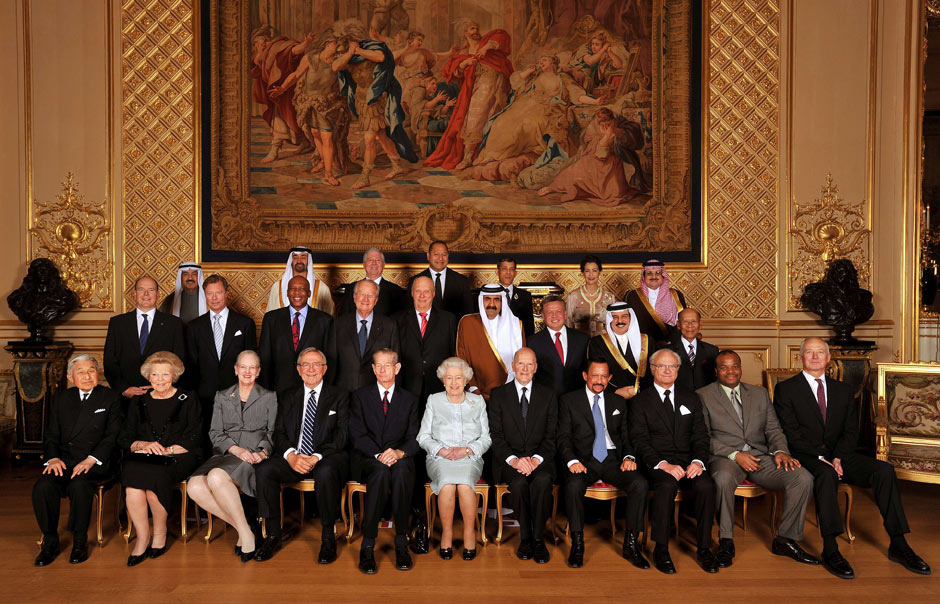
The Queen poses for a formal picture with her guests before a sovereign monarchs jubilee lunchView larger picture
The Queen poses for a formal picture with her guests before a sovereign monarchs jubilee lunch at Windsor Castle. Photograph: John Stillwell/AFP/Getty Images

It was meant to be a monarchical milestone, an unprecedented meeting of the world's crowned heads gathered at Windsor Castle in celebration of theQueen's diamond jubilee.

But as the kings, queens, princes, one emperor, a grand duke and an emir posed for a historic photograph inside the castle's Waterloo Chamber, elsewhere human rights activists condemned it as a platform for "blood-stained despots and tyrants".

Perhaps, the Queen's advisers may have reflected, this glittering anniversary bash was not such a good idea after all.

Taking his seat amid the heraldic splendour of St George's Hall, was King Hamad al-Khalifa of Bahrain, whose regime is accused of the brutal suppression of pro-democracy demonstrations.

Swaziland's controversial King Mswati III, who has amassed 13 wives and an estimated £60m personal fortune, according to Forbes magazine – while many of his 1.2 million subjects live in poverty – was seated nearby.

Saudi and Kuwaiti royals, criticised for their human rights records, also feasted from a menu which included English asparagus, Windsor lamb, wild mushrooms and Kent strawberries, paid for by the taxpayer, via the Sovereign's Grant.

The Queen had rolled out the full red-carpet treatment with the Duke and Duchess of Cambridge, Prince Harry and princesses Beatrice and Eugenie among a 12-strong royal welcoming party. Prince Charles was not there, as he was hosting his own glittering dinner at Buckingham Palace on Friday night for the foreign rulers, excluding King Hamad, who was not attending.

The Queen welcomed the Bahraini ruler with a handshake and a laugh as the two shared a joke.

But detractors condemned the event as a "catastrophic error of judgment". It was, pronounced the chief executive of the pressure group Republic, Graham Smith, a "crisis of her [the Queen's] own making". "Thanks to the Queen's misjudgment, her jubilee will forever be associated with some of the most repressive regimes in the world," he added.

Denis MacShane, a former foreign office minister, said: "Given the amount of blood on the hands of the royal regime in Bahrain it's a shame he will stain the white linen of Windsor Castle at this event."

MacShane laid responsibility at the door of the Foreign Office. It has said invitations were sent by the royal household. Some 21 sovereign monarchs, and six representatives, made up the largest such gathering of foreign royals since Queen Victoria's golden jubilee celebrations, captured in a painting by Laurits Tuxen. Not all, though, still had thrones – the royals of Bulgaria, the former Yugoslavia and Romania, for example, and the Hellenes. In the formal photograph, King Hamad was a diplomatic distance away from the Queen, though that was because the seating appeared to be arranged on length of regal service.

Showing no indication of being aware of the controversy surrounding his attendance, the Bahraini ruler convulsed into a fit of giggles as the photographer began taking the picture. Also laughing was the Sultan of Brunei, sitting in front. "Are you supposed to be enjoying this?" joked the Queen.

In some respects the lunch was something of a family affair featuring Europe's three queens: Elizabeth II, 86, Margrethe II of Denmark, 72, and Beatrix, of the Netherlands.

Many guests were the Queen's "kissing cousins", which happily dispensed with protocol over who should pay obeisance to whom. Queen Beatrix flung open her arms as she approached the Queen, before kissing her.

Bowing and curtsying was limited. Lest anyone be doubt as to who had precedence, however, it was Her Majesty - with Great Britain and 15 other realms notched on her belt. This being lunchtime, it was lounge dress and no proper bling.

The ghost of Victoria loomed large. Not for nothing was she known as the "grandmother of Europe", with her descendants present including the Queen, Prince Philip, Margrethe, King Harald of Norway, 75, and King Carl Gustaf of Sweden, 66.

Another would have been Spain's Queen Sofia, but she was prevented from attending by her government, furious over a planned visit by the Earl of Wessex to Gibraltar, the UK overseas territory Spain wants back.

Protesters stayed away from Windsor, except one, who called himself Joe. Others were planning to demonstrate outside Buckingham Palace on Friday evening, an event, as it turned out, the Bahraini ruler was not due to attend.

The Swazi Vigil protest group had waved placards outside the Savoy hotel, where Mswati was said to be installed with a 30-strong entourage, rather than Windsor. They did not, said protest co-ordinator Thobile Gwebu, want to "spoil" the Queen's jubilee celebrations. But, she added, they had written to Her Majesty politely asking if she could perhaps "have a word" with the Sherborne-educated absolute monarch.

Joe, meanwhile, waved his placard as the crowned heads arrived in cars at the Long Walk at Windsor Castle. "I booed at the King of Bahrain's car," Joe said proudly. "But right behind it was the Emperor of Japan's car. I was still booing and the Empress had the window down and was waving. She looked a bit startled and stopped waving straight away," he said.

Alan Milburn: 'Threat to new era of social mobility' Major report warns that fewer people outside the middle class have a chance to join professions Daniel Boffey, policy editor guardian.co.uk, Saturday 26 May 2012 23.57 BST

Alan Milburn: 'Threat to new era of social mobility'

http://www.guardian.co.uk/society/2012/may/26/alan-milburn-social-mobility

Major report warns that fewer people outside the middle class have a chance to join professions

Alan Milburn
Britain has a chance to recreate the 1950s ‘golden era’ of professional opportunities, says Alan Milburn. Photograph: Matthew Fearn/Press Association

The government's adviser on social mobility will warn in a major report that the country risks squandering the chance to recreate the golden era of the 1950s, when workers from all parts of society had the chance to join the professional classes.

Alan Milburn, the former Labour health secretary, will tell ministers that despite a huge growth in white-collar work, there is evidence that people from poorer backgrounds and those living outside the south-east of England are being left behind.

The report, due to be published on Wednesday, claims that 83% of all the jobs created over the next decade will be in the professions. Today, 42% of the working population (13 million people) work in a profession and by 2020 this will increase to 46%.

Yet, in an example of the increased social exclusivity of the top echelons in Britain, Milburn found that while 30% of members of parliament were privately educated in 1997, that proportion increased to 35% in 2010. In the Labour government's last cabinet, 32% were privately educated but this increased to 59% in the coalition cabinet that entered Downing Street in May 2010.

Speaking to the Observer, Milburn said the country had the opportunity to encourage a level of movement between the classes last seen in the 1950s but that he had found no evidence of this happening. He said: "The chances of social mobility are greater if there are more professional jobs being created. So it is no coincidence that the 1950s saw an unparalleled social mobility in Britain and that coincided with an upsurge in professional employment.

"In the 1950s, the academics say there was the creation of more room at the top. The economy was becoming more professional, more white-collar jobs created, demands [increased] for higher quality, higher skill level and the sucking up of labour into the white-collar, better-paid jobs.

"The primary reason that social mobility has stagnated in the last 30 years is that there has been another big change in the labour market: the advent of a more knowledge-based economy where there is a high premium on qualification and skill and if you have those you get into the inner circle, if not there is constant insecurity, low pay and endemic poverty."

Milburn added: "It seems that what is happening, as part of this growth of the middle class in our country, is that the jobs that are going to be created are overwhelmingly in professional careers. The question is: who gets the jobs? There is a real opportunity.

"And so the question at the heart of the report is whether the growth in professional employment is going to create a new social mobility dividend for Britain just as there was in the 1950s. And the short answer is: not yet."

Milburn's report – the first of three on social mobility commissioned by deputy prime minister Nick Clegg – will tell ministers that the recruiting policies of big employers are largely responsible for the lack of social progress.

He found that of the 115 universities in the country, on average only 19 are targeted by the UK's leading professional employers as part of their graduate recruitment drives. Milburn, who also examines the role of universities and government in causing and or, possibly, solving the problem, said: "Those universities are the more socially exclusive in the country so those recruitment practices merely enforce the social exclusivity of the professions. It is an interesting argument that of the 115 universities only 19 are capable of producing excellent graduates. I think there are 30-odd universities in the Russell Group alone. So they don't even get to all of them." Evidence suggests that the "socially exclusive" recruitment policies of the major employers exacerbate the north-south divide.

Milburn will call for employers to follow the example of the last two governments in moving civil service jobs to the regions.

He said: "We looked at where the Times top 100 graduate employers, who were overwhelmingly professional employers, were offering vacancies. In 2012, nine out of 10 of those companies were offering vacancies in London. Only 44% in the north-east; only 41% in East Anglia. Unsurprisingly in the next few years, over half the growth of jobs in higher-level occupations will occur in London and the south. It seems that regional disparities in being able to get on the professional career ladder are growing. And are set to go on doing so.

"Interestingly, the previous Labour government, and this one, have set a rather good example in that they have actively dispersed their civil service workforce . And as a consequence they created new white collar opportunities in the regions and other nations of the UK. What these regions have going for them from an employer's perspective is there is a youthful labour market and a cheaper labour market. Which is of course why the government has done it.Maybe where the government has led, the professions can follow."

the guardian - polly toynbee - Queen's diamond jubilee: a vapid family and a mirage of nationhood. What's to celebrate?

theguardian

01.06.12
Updated 11.10

http://m.guardian.co.uk/commentisfree/2012/may/31/queen-diamond-jublilee-why-celebrate?cat=commentisfree&type=article

Queen's diamond jubilee: a vapid family and a mirage of nationhood. What's to celebrate?

If the very idea of monarchy diminishes us, the living reality is much more humiliating and damaging to our country
Joe Magee 0106
Illustration by Joe Magee
Polly Toynbee

The Guardian, Thu 31 May 2012 21.00 BST

Comment

The mighty royal jubilee bells will toll their way down the Thames on Sunday on a floating belfry leading a thousand boats, echoed by pealing church bells all down the riverside. Who could miss the spectacle of a hundred tall ships serenaded with Handel's Water Music played by a floating orchestra?
The more outrageously glorious the performance, the more preposterous its purpose. There at the heart, in the dead centre of all this pomp and circumstance, is the great emptiness, the nothingness, the Wizard of Oz in emperor's clothes. The louder the bells, the more gaping the grand vacuity. What are we celebrating? A singularly undistinguished family's hold on the nation, a mirage of nationhood, a majestic delusion.
How close to religion it is, with all the same feudal imagery, God as Lord and sovereign, sovereign anointed by God, knelt before in a divine hierarchy of power ordained by laws too ineffable to explain. The tyranny of the monarchy lies not in its residual temporal power but in its spiritual power. It subjugates the national imagination, infantilising us with false imaginings and a bogus heritage of our island story. For as long as they rule over us, we are obedient servants, worshipping an ermine-wrapped fantasy of Englishness. (Despite the kilts, the monarchy was never really British.)
Every country needs its founding myths, its binding identity rooted in a valiant story that rarely stands up to historical scrutiny. What matters is the nature of that story, and ours is as pitiful as our embarrassingly shoddy national anthem: no US "land of the free", just "long to reign over us".
But if the very idea of monarchy diminishes us, the living reality is even more humiliating. What are we doing paying homage to the unimpressive personages invested with this awe? They are the apogee of celebrity culture, because there is nothing there but empty celebrity. Ah, say the royalists, it's their very "ordinariness" that is their mystique. But they are not ordinary like next-door neighbours, only ordinary like all the other dull and talentless plutocrats with nothing remarkable about them but their bank balance. That the very rich are mostly very dull, lacking enterprise, initiative or inspiration is small solace.
The long line of royal nonentity is the ultimate lesson in the damage that inherited money and privilege does, the reason why inheritance tax – which the monarchy doesn't pay – is a way not just to collect funds for the Treasury but to stop the stultifying social effects of inherited wealth. How well the royal family illustrate the aristocratic phenomenon where those who have had the very best education and the greatest opportunity for intellectual enrichment emerge with so little to show for it, generation after generation. Hunting, shooting, horses, nightclubbing, none of the long royal line since time immemorial has exhibited much spark of intellectual curiosity or originality.
It is a joyful confirmation of the wonder of the human gene pool that talent, brains and charm spring up at random. These faculties are no more bred out of a fictional "underclass" than they are bred into a fictional "royal blood", though social circumstance conspires to knock it out of some at a young age, while promoting others with no attributes to heights they would never reach on merit. If royals have any value, they are the living, breathing negation of the myth of genetic superiority.
The most enjoyable reminder was theQueen's diamond jubilee "informal" lunch for 20 crowned heads, when the theatre of majesty descended into farce. If she thought collecting them together would add legitimacy to the bloodline idea, what a mistake. The display of dictatorship and delusion surely must have been devised by some secret palace republican, complete with group photo of the torturers of Bahrain, Saudi Arabia, Swaziland and Qatar, alongside dethroned fantasists from Romania and Greece, a showcase of royalty from horror to hilarity, from ruthless to Ruritanian.
With its usual thundering ineptitude, the government chose jubilee week to publish a report on Britain's social immobility. Alan Milburn offers a snapshot of a country where birth is destiny more surely than virtually every other OECD nation except the US. With 83% of new jobs in the next eight years in higher management and the professions, on the present trajectory the odds that many more children from blue collar backgrounds will shoot up the ladder to take them are vanishingly remote.
New opportunities, like the last decade's extra university places, are taken by dimmer, better-crammed children of a middle class more adept at cementing their children into the upper echelons than ever. The privileged are not about to let them slip down the ladder to make room for others any time soon, and Michael Gove's selective education policies will help prevent it. Income gaps stretch wider, as the bottom half has stagnated for a decade. Nick Clegg's claim that income difference is unlinked to opportunity defies every international comparison: only more equal countries produce more equal opportunities. But here we are, in a deeper depression than the 1930s, with austerity imposed hardest on the weakest, lavishly celebrating our figurehead of British class rigidity.
The cost of the monarchy, though a hundred times the price of the modestly likeable Irish presidency, is counted not in palaces and royal trains, but in the fantasy of imperial power the crown bestows on British politics. Punching above our weight, we have just ordered a new Trident to cling to an undeserved UN security council seat from which to hector the world about a democratic idea so weakly applied at home.
Meanwhile, defrauding ourselves and the world's treasuries, the sun never sets on the Queen's dominion over more tax havens than any other country, an archipelago of shame from the Channel Islands, the Isle of Man, the Cayman Islands, Turks and Caicos, Gibraltar, Bermuda, the British Virgin Islands – and the City itself. Beneath the splendour, the squalor.
The Republic protest takes place at City Hall at 1.30pm on Sunday

Flickr - projectbrainsaver

www.flickr.com
projectbrainsaver's A Point of View photoset projectbrainsaver's A Point of View photoset